
#290: Harrower Laboratory & Clinic (Glendale)

Added to the National Register of Historic Places on March 31, 2025
The first thing I noticed about Harrower Village when I visited in the spring of 2026 was how vibrant it looked on the outside. The dark red brick played against an electric blue sky and wispy clouds, like the building was participating in some kind of patriotic marketing exercise. The actual stars ‘n stripes flapped on a flagpole out front.
Harrower Village was just a year into its life as an affordable senior housing facility when I saw it. But three of its buildings had already lived many lives over the past century and change.
Harrower Village was originally the Harrower Laboratory & Clinic, commissioned by the controversial endocrinologist Dr. Henry R. Harrower. Born in London, Harrower ping-ponged between America and Europe in the early 1900s to pursue his medical bona fides. During four years in France and Italy, he was turned on to the emerging practice of organotherapy: the practice of treating patients for various ailments with extracts of animal or human organ tissue.
Despite some well-publicized testimonials from patients and doctors who claimed they were cured by consuming secretions from a sheep’s thyroid or bull testes, there was very little scientific research proving the effectiveness of organotherapy. Nevertheless, Harrower published three books on the subject, pumped out papers to hype his findings, edited the first two issues of the journal Endocrinology, and in 1916 co-founded the Association for the Study of Internal Secretions. He claimed in 1922 that more than 6,000 American doctors were using his treatments successfully.

Was Harrower a quack? Well, it depends on who you ask, and how you define “quack.” Harrower kept up with and responded to the latest advances in endocrinology, like you’d hope a legitimate doctor would, and he was willing to modify his theories based on contrary evidence. For example he conceded by 1930 that the hormones adrenalin, oxytocin and insulin were most effective when injected, instead of taken orally, like he had prescribed for years.
But Harrower also caught a lot of flak from the medical establishment for espousing two controversial, unproven ideas:
- Homostimulation: you can heal an internal organ by consuming extracts from that same organ
- Harrower’s Hypothesis of Hormone Hunger: If you consume a mix of extracts from multiple organs, your endocrine system will sort out which ones are needed, and discard the rest without harming your body

The other complicating factor was money. His critics were dismayed that he had forged a commercially successful business, selling more than $1 million of “medicine” per year based on ideas that weren’t accepted by the endocrinology mainstream. Harrower moved to Glendale in 1915, and three years later founded a laboratory on the second floor of a bank building at Broadway & Glendale Avenue. There he developed and manufactured dozens of varieties of an organotherapeutic tablet called Sani-tate, meant to stimulate the glands. For a long while the Harrower lab was Glendale’s largest business, employing over 100 people in Glendale alone, and at its height it operated branches in Baltimore, New York, Chicago, Denver, Kansas City, even London. Was Harrower’s financial success proof of quackery? Not necessarily, but the fact that he had a financial stake in promoting potentially dangerous, unproven therapies didn’t help him persuade his more skeptical colleagues.
Surely nothing will discredit the subject in which we have a common interest so effectively as pseudoscientific reports which find their way from the medical press into advertising leaflets, where, cleverly intermixed with abstracts from researchers of actual value the administration of pluriglandular compounds is promiscuously advocated for a multitude of symptoms, real and fictitious.
-Henry Cushing, “Disorders of the pituitary gland. Retrospective and prophetic” (JAMA, 1921, vol. 76)
By 1920 Harrower’s business had outgrown the rented space, so he decided to move his Glendale headquarters to a permanent home. He commissioned local architect Alfred F. Priest to design him three buildings on a lot at Broadway & Belmont Street. Though they were all designed as a cohesive campus, they went up piecemeal between 1921 and 1924.


The first building of the Harrower Laboratory & Clinic was the chemical manufacturing building on the west side of the property, finished in early 1921. This was the simplest of the three, a flat-roofed, double-height one-story rectangle with a basement and small two-story segment at the south end, all made of brick. Ornamentation was limited to a couple brick stringcourses running along the top, and brick sills and lintels lining the wood-frame windows. Originally a garage jutted out from the south side of the building, but it was demolished somewhere in the 1980-2002 range. You can still detect where the original windows were filled in with brick after the demolition.
The chemical manufacturing building housed equipment capable of packing 120,000 Sani-tate tablets per day, wrapped in wax paper to ward off moisture. In another large room, the mailing department prepared tablets for shipping, and sent out copies of Harrower’s writing to a prodigious mailing list of doctors and researchers. According to the Glendale Daily Press, the Harrower Laboratory & Clinic sent out some 100,000 pieces of mail per week – enough that the local post office couldn’t keep up with the demand for postage. Harrower had to petition the feds to stock his own cache of stamps, and install a cancellation machine.

Alfred Priest’s plan for the second building was executed in fall of 1921, under the supervision of designer Leonard M. Hodge. This was the main administration building, and architecturally it reflected its role as the centerpiece of the Harrower Laboratory & Clinic. Its refined Beaux-Arts exterior was punctuated with decorative brick patterns to contrast with the standard running bond patterns; concrete medallions and brick quoins on the corners added visual and textural interest, and a decorative concrete pediment covered the entrances on the north and east sides of the building, inset with the letter “H.” On the inside, the original wooden, double-wide staircase and balustrades still impress today. This was $47,000 well spent.


The admin building contained 28 rooms where a passel of executives and secretaries kept the company functioning. Downstairs there were admin offices, a library and Dr. Harrower’s examining room downstairs, along with a full editorial department, pumping out marketing materials. Upstairs was the bookkeeping department, a ladies room and kitchen and an assembly room. There was even a full-time polyglot fluent in seven languages, hired to manage a collection of foreign medical journals.
The new Harrower Laboratory & Clinic formally opened on November 28, 1921, soon after the admin building was completed. Hundreds of well-wishers were treated to musical selections and a long list of speakers, including Glendale Mayor Spencer Robinson, the VP of the Glendale Chamber of Commerce, the President of the Glendale Physicians’ Club, and of course, Dr. Harrower himself. A social hour followed. No reports on whether any food was served, but if so, it was probably, uh, offal.

Three years later the final building of Harrower’s campus went up: the Harrower Foundation Clinic, a 38-room collection of research labs, exam rooms, x-ray rooms, waiting rooms and doctor’s offices. Here Harrower employees used state-of-the-art medical devices to conduct experimental research on how organotherapeutic treatments impacted diseases, both glandular and non-. It was supposedly one of the first endocrinology clinics in the US.


While the staff’s clinical research clearly benefited Harrower’s commercial ambitions across the courtyard, all treatments and research trials at the clinic were free, a point that he made sure to stress as a direct rebuke to those who criticized him for profiting off his methods. “As for opposition, I am grateful for it,” he told an assembly of doctors at the clinic’s opening on November 10, 1924. “The clinic will be a potent factor in opposing opposition.”
Architects Lindley & Selkirk (also known for the Alex Theatre & Hotel Glendale) were responsible for the clinic building, but it fits in so seamlessly with Alfred F. Priest’s designs for the other two that you would never guess it was the work of two different guys. On the outside you’ve got the same brick patterns, cornice and brick/concrete embellishments as the admin building. Even the lintel with its inset “H” on the clinic’s east elevation is identical to the ones on the admin building. As if to underscore the visual connections between the two, an original pedestrian bridge connects the upper floors of the two buildings.

For over 25 years Henry Harrower ran his clinic from Glendale despite a complete disavowal of organotherapy by the American Medical Association. He continued to teach and lecture, and by all accounts was both a successful entrepreneur and a model citizen. He was a member of prominent business and social organizations in Glendale, and helped to bring a Southern Pacific station to the area. He even visited President Harding in DC to advocate for an independent post office in Glendale. The request wasn’t approved, but he came home with an autographed photo of Harding, which was prominently displayed in the lobby of the admin building.

In 1930 Harrower donated an organ (the musical kind – important to specify when you’re talking about endocrinologists) to the Seventh Day Adventist Church in Eagle Rock. A 1990 letter in the Los Angeles Times tells the story of a different kind of organ donation: when the nanny of the Harrowers’ daughter became extremely ill but couldn’t afford surgery, Dr. Harrower gave her an experimental liver extract for free that got her through the illness.
Meanwhile, the Harrower Laboratory & Clinic was going through changes. Several stories from 1931 suggest that the buildings were acquired by Cecil B. DeMille Productions, Inc., and then leased back to Harrower. Harrower’s company was purchased by Lambert Pharmaceutical Co. (marketers of Listerine) in 1944, the same year that four Harrower employees were injured in an explosion while making penicillin. In 1946, Lambert started eyeing a 23-acre parcel in the leafy Verdugo Woodlands neighborhood; by 1950 the lab had vacated the original three buildings on Broadway & Belmont, and the Los Angeles College of Chiropractic announced it was moving in, with a school and active clinic.

Dr. Harrower passed away in 1953 at his home in the Pacific Palisades. With its leading evangelist gone, organotherapy faded. The group Harrower co-founded, the Association for the Study of Internal Secretions, was renamed the Endocrine Society the year before he died; they’re still going strong today.
In 1977 Glendale created a local preservation ordinance to protect its historic landmarks. The Harrower Laboratory & Clinic was part of the first batch of sites to be protected. It was in good company. Eight buildings from that first batch are now also listed on the National Register of Historic Places: the Verdugo Adobe, Doctors House, Southern Pacific Railroad Depot, Glendale YMCA, Hotel Glendale, Grand Central Air Terminal, Alex Theatre and the Derby House.
In the ‘80s and early ‘90s, the old Harrower lab buildings housed a computer systems vendor, then a medical records company. Beginning in 1994 Tobinworld, a mental health center and school for people with special needs, occupied the space for 25 years.

The Harrower Laboratory & Clinic’s current phase began in 2019, when the City of Glendale Housing Authority bought the property for $12.1 million, with the intention of adaptively reusing it as affordable housing for seniors. Included in the deal was a vacant commercial building across the alley to the west, but unrelated to the Harrower Lab complex. As described by the City of Glendale that year, the purchase was part of “the most significant and largest investment the City has made to date for affordable housing purposes.”
The City of Glendale partnered with Abode Communities to develop a new housing project called Harrower Village. The idea was to restore the three existing historic buildings, convert them for residential use, and add a new building to the south edge of the property, for a total of 39 units plus a manager’s unit. As a separate project, the Glendale Housing Authority demolished the vacant building to the west of the lab, and built another affordable housing complex called Citrus Crossing.

Glendale and Abode Communities brought in the architecture firm Omgivning to design and carry out the project. Omgivning’s Managing Director Joel Chappo still recalls the state of the place when he first toured it. “The admin building had been overgrown,” Chappo told me. “There were vines that were covering the whole front of the building…you couldn’t see any of the details that were beyond. And then walking through the spaces…There were desks and books scattered around, there were all the paintings of animals on the walls, it felt like a school that had been left abandoned.”


Also crucial to the project were the historic resources consultants at Architectural Resources Group (ARG). According to ARG Associate Principal Evanne St. Charles, who prepared the National Register nomination form for the Harrower Laboratory & Clinic, this one presented a unique research challenge. “We didn’t have a lot of historic documentation,” St. Charles said. “No historic drawings, and very few historic photographs. So we relied heavily on newspaper articles that were written in the Glendale Evening-Press and various other local articles that went into great detail about the design and construction of the property, which were really helpful in better understanding historic finishes, the original uses of each of the buildings, and how they functioned historically.”
All that research was necessary to ensure that the rehabilitation work met the Secretary of the Interior’s Standards for the Treatment of Historic Properties – a condition for securing federal and state tax credits for the Harrower Village project. Historic research also guided many of the design choices the team made. “We went back and forth about what would be the appropriate color choice, for instance, for the windows,” St. Charles told me. “And decided to go for a lighter, creamy color for the windows…even though we had black and white photographs, it was clear it was a lighter shade compared to the darker brick.”

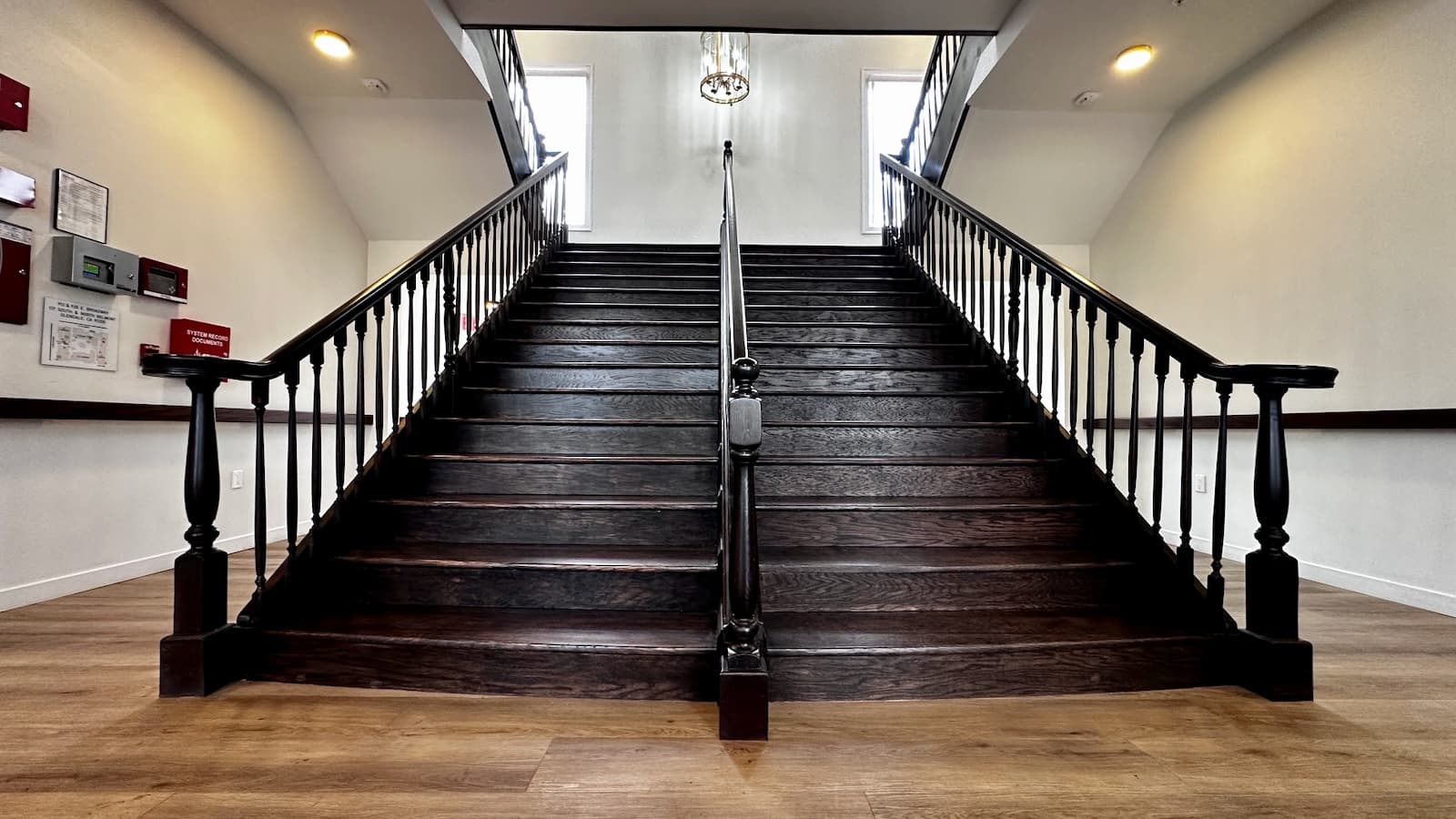
The interiors of each building underwent an extensive overhaul. “There wasn’t much historic fabric left in the building[s], other than the central stairs and the circulation configuration – the corridors, the entry lobbies,” Chappo admitted. The team designed an arrangement of apartments that preserved the original layouts of the admin and clinic buildings – with rooms on either side of the corridors – and made 50% of the rooms fully accessible. They also refurbished the staircases of the admin and clinic buildings, and removed a non-historic stairwell from the south end of the clinic building.


Over across the courtyard, a portion of the chemical manufacturing building was repurposed and configured as a community space, with cork flooring and bountiful natural light flowing through windows and a skylight. On the outside west wall, there’s a covered entrance porch that juts out into the alleyway and functions as a sun room for one of the three units in the building. While the entrance porch isn’t original to the property, it’s adorable, so they kept it. That alleyway, once a utilitarian passage of cracked concrete, is now a nicely paved pedestrian paseo that connects Harrower Village with the Citrus Crossing complex next door.

On the south end of the courtyard is the two-story new addition, with 12 units inside. While it doesn’t contribute to the historic-ness of this site, it needed to meet the Secretary of the Interior’s standards about how new builds on historic properties should interact. “New construction has to be compatible in size, scale, massing and overall design,” explained St. Charles. “It should be subordinate to the historic buildings on the property. And if possible, less visible from the public right of way. Which we believe with the Harrower Lab addition, we did very well.” There is continuity with the use of brick and the proportions of the windows borrowed from the historic trio of buildings. But there was also a deliberate choice to use a different brick color palette, and to build it on top of the old basketball court, which wasn’t visible from the street.


Tying the four buildings together is the central courtyard. When Glendale bought the property in 2019 it was a motley mix of astroturf, concrete, the basketball court and the lavender droppings of jacaranda trees. Omgivning’s new design removed all of the non-historic landscaping/hardscaping and introduced a circular grass bed at the center, plus walkways, planter beds, benches, shaded seating areas and new trees.

The thoughtful design of Harrower Village takes into account the unique needs of seniors. There are the obvious modifications to accommodate those with mobility issues – new elevators in the admin building and the new addition, handrails in the hallways, etc. – but also less overt decisions in the design of the courtyard and elsewhere meant to encourage physical activity and a sense of community among its tenants.
Omgivning’s Joel Chappo is chuffed that Harrower Village unites three important goals: historic preservation, creating affordable housing and providing housing for seniors. “We want to prove what’s possible with existing and historic structures, and show that untapped potential that can exist,” he said. “Whether it’s for seniors, for residents, for office users – that all comes together [here].”
The most moving reactions to Harrower Village that I’ve heard were from two of its actual residents. At the grand opening on May 13, 2025, Roobina Hovsepian spoke about living there after being evicted from her previous home: “Every time I open that door with my key, I get the warm home feeling again.” Just before snipping the ceremonial ribbon with an oversized scissors, Miriam Vardanyan enthused “When you just go inside the unit, these big windows, these high ceilings, wonderful flooring, all new appliances…I feel so comfortable.”


70+ years after Dr. Harrower’s death, his theories are but a footnote in medical history, but the three buildings he brought to Glendale have continued to inspire new uses. They could very well end up as Henry Harrower’s most lasting legacy.
Thanks to Joel Chappo of Omgivning and Evanne St. Charles of Architectural Resources Group for the tour and interviews, to Jordon Johnson of Omgivning for supplying historic imagery and footage, and to Katie Dunham for her publicity prowess.
Resources & Recommend Reading
+ “Adventists Dedicate New Organ Friday” (Los Angeles Herald Examiner, April 10, 1930 – via newspapers.com)
+ “College Will Open Building” (Los Angeles Examiner, May 1, 1950 – via newspapers.com)
+ Colvin, Dorothy: “Letters: Dr. Harrower’s Good Deed” (Los Angeles Times, October 18, 1990 – via newspapers.com)
+ “Doctor Defends New Treatment” (Brooklyn Daily Times, March 3, 1922 – via newspapers.com)
+ “Doctors on Inspection of Clinic” (The Glendale Evening News, November 11, 1924 – via newspapers.com)
+ “The Doorway to Health” (AD – Eagle Rock Sentinel, April 5, 1951 – via newspapers.com)
+ “Dr. Harrower Marks Fourth Anniversary” (Glendale Daily Press, April 7, 1922 – via newspapers.com)
+ “Dr. Harrower Services Set” (Los Angeles Examiner, January 4, 1953 – via newspapers.com)
+ “Dr. Harrower Tells of Early Work” (Glendale Daily Press, June 17, 1922 – via newspapers.com)
+ “Dr. H. Harrower Given Honors on His Birthday” (The Glendale Evening News, April 30, 1921 – via newspapers.com)
+ “Dr. H. R. Harrower Laboratory Will Have Opening” (The Glendale Evening News, November 26, 1921 – via newspapers.com)
+ “First Laboratory Unit Being Erected” (Pasadena Post, November 11, 1920 – via newspapers.com)
+ “Gains Renown in California” (Battle Creek Moon-Journal, January 24, 1925 – via newspapers.com)
+ “Gets President’s Autograph But No Glendale Postoffice” (The Hartford Sentinel, July 11, 1921 – via newspapers.com)
+ “Glendale Register of Historic Resources” (glendaleca.gov, updated January 2025)
+ “Glendale Site in Realty Deal” (Los Angeles Times, July 19, 1931 – via newspapers.com)
+ “Harrower Co. Okays New Glendale Site” (Los Angeles Evening Citizen News, November 25, 1946 – via newspapers.com)
+ “Harrower Has Opening Fine Laboratory” (Glendale Daily Press, November 29, 1921 – via newspapers.com)
+ “Harrower Village” (Omgivning.com)
+ “Harrower Village Grand Opening” (VIDEO – @MyGlendale on YouTube, June 6, 2025)
+ “Hundreds Attend Formal Opening of Harrower Laboratory Under Auspices Chamber of Commerce” (Glendale Evening News, November 29, 1921)
+ “Important Realty Deals Transacted During Past Week” (Pasadena Star-News, August 22, 1931 – via newspapers.com)
+ “Lions to hear Talk by Doctor on Glands” (Evening Vanguard, May 22, 1940 – via newspapers.com)
+ “New Business Has Phenomenal Growth” (Los Angeles Times, November 27, 1921 – newspapers.com)
+ “New Clinic for Gland Study Is to Open Today” (Los Angeles Times, November 10, 1924 – via newspapers.com)
+ “New Quarters of Dr. Harrower About Ready” (Glendale Daily Press, September 8, 1921 – via newspapers.com)
+ “Omgivning Celebrates the Opening of Harrower Village” (Press release – via Katie Dunham Communications)
+ “Ordinance Proposed to Preserve Glendale Landmarks” (Los Angeles Times, July 3, 1977 – via newspapers.com)
+ “Penicillin Blast Hurts 4” (Los Angeles Examiner, June 28, 1944 – via newspapers.com)
+ Schwartz, Theodore B., MD: “Henry Harrower and the Turbulent Beginnings of Endocrinology” (Annals of Internal Medicine, Volume 131, Number 9, November 2, 1999)
Discover more from Etan Does LA
Subscribe to get the latest posts sent to your email.

- Etan R.
Music omnivore, student of LA history, beer snob and amateur father. Working my way through the canon.
- #290: Harrower Laboratory & Clinic (Glendale) September 19, 2026
- #289: Malabar Branch Library (Boyle Heights) September 3, 2026
- #288: Pacific Electric Building (Downtown) August 18, 2026
- #287: Carthay Neighborhoods Historic District (Mid-Wilshire) August 3, 2026
- #285: Saban Theatre/Fox Wilshire (Beverly Hills) July 11, 2026