
#291: South Pasadena Historic Business District

Added to the National Register of Historic Places on July 21, 1982
There’s a remarkable photo of South Pasadena as it looked in 1893, taken from the hills just southwest of the city. In the distance atop another hill is the Raymond Hotel, the area’s most prominent tourist attraction at the time.

What I love about this photo is how well it documents a city in transition. At the time South Pasadena had only been incorporated as a city for five years. Much of the land was still covered in neat rows of citrus trees, a vestige of the previous 20 years when the San Gabriel Orange Grove Association – many of them settlers from Indiana – planted orchards and vineyards.
But you also see evidence of South Pasadena’s changeover from rural colony to small city. At left, we see the original S-shaped route of the Santa Fe Railroad that brought visitors to the area. It curves between the Graham & Mohr Opera House and the South Pasadena Hotel on Center Street (now El Centro). Look further east on that same road, and you’ll see the Center Street School and a Methodist church. All four of those buildings are gone now.

The 13 buildings and one watering trough that make up the South Pasadena Historic Business District collectively tell the next chapters in the story of South Pasadena. The oldest structure in the district went up in 1886, the youngest in 1928. The 42 years in between witnessed South Pasadena’s population explode from under 600 to around 13,000. New interurban streetcar lines brought South Pasadena within closer reach of Angelenos, and the famous Cawston Ostrich Farm lured in tourists from all over.
The business district centered around Mission Street and Meridian Avenue supported all of that growth in South Pasadena’s formative years. And while much of the city’s commercial action has since shifted eastwards to Fair Oaks Avenue, the District is still a vital part of South Pasadena’s identity.
Let’s take a dip into the stories of every contributor to the South Pasadena Historic Business District, in chronological order according to when they were built.
Altogether this new block gives that part of town quite the air of a city block where population is much greater than it is here. And what is better still, the people of South Pasadena are getting down to the habit of patronizing home industry in their purchases to an extent that is making itself felt in the business of the city. And this is as it should be.
– South Pasadenan, November 8, 1906
Meridian Iron Works (913 Meridian Avenue)
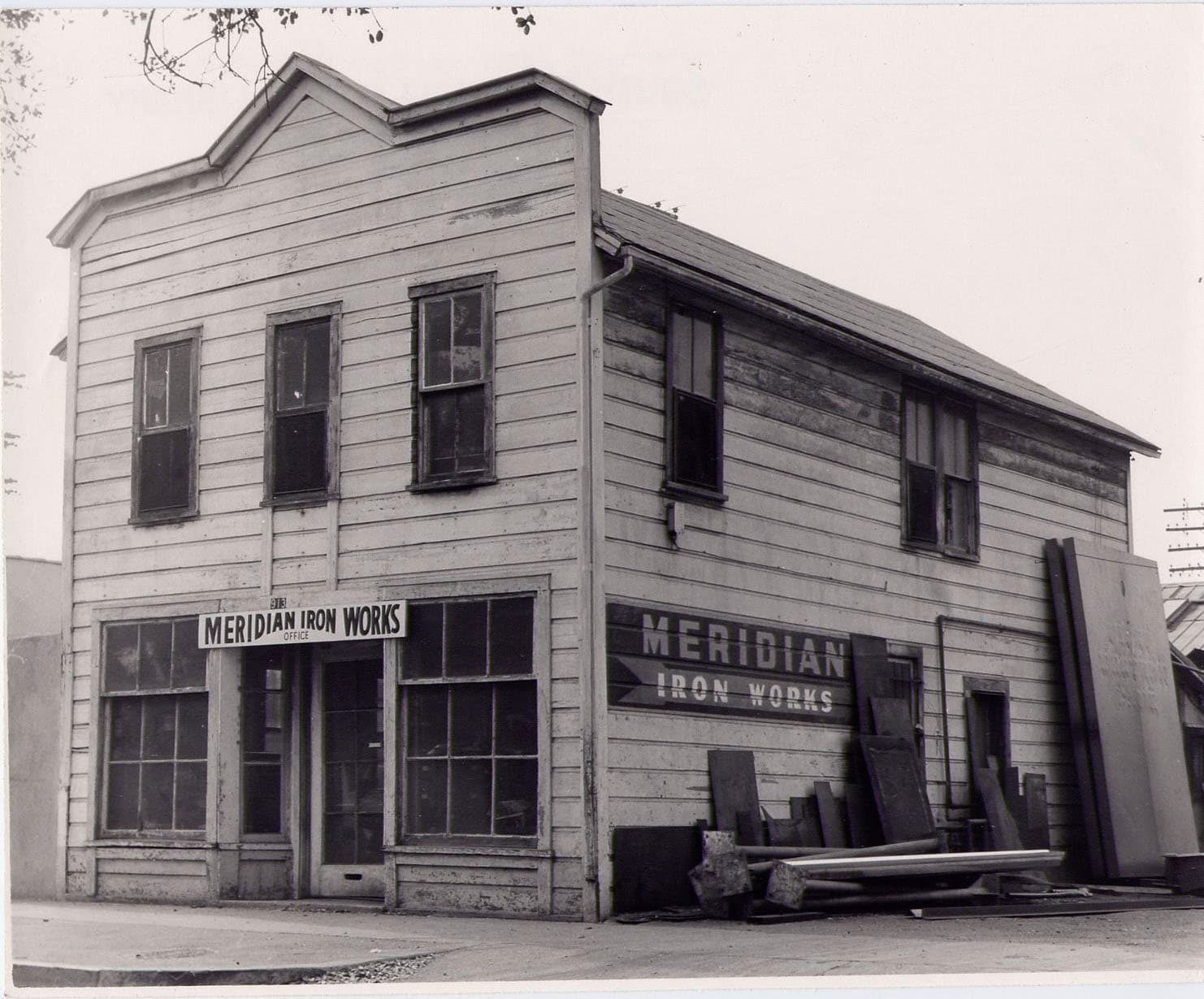

This simple redwood frame building is the oldest structure in the South Pasadena Historic Business District. With its Victorian-style false front, it looks like everyone’s stereotype of a smalltown Main Street general store – and it actually was one. It’s been there since 1886, just after a rate war between the Santa Fe Railroad and Southern Pacific drove down the cost of travel to Los Angeles to as little as $1 a one way trip. That’s a significant fact because the Meridian Iron Works building was just half a block north of the Santa Fe Depot, perfectly placed to attract fresh-off-the-train visitors.
In the 1880s and 1890s the general store was tended by Aaron McReynolds, a South Pasadena resident since 1883, before the city was a city. McReynolds was South Pasadena’s first railway agent, but after a few years he turned that job over to his wife May to focus on selling groceries and drugs in his new building at 913 Meridian Avenue. He was also a telegrapher and City Clerk, and rented out hotel rooms upstairs (if the tales are true, prostitutes tended to amorous guests there).

From a house of ill repute to a house of god: 913 Meridian hosted the Church of the Nazarene in the 1930s (May McReynolds was an ordained minister), plus homemaking classes led by the Red Cross and a Japanese language school. In 1940, a fictitious business name notice showed up in the local papers for Meridian Iron Works, owned by Raymond Mowrer.

Years before he ran an actual foundry under the name of Meridian Iron Works, Mowrer operated a bicycle shop in the building. By the end of the ‘40s the bikes were out, and the metalsmithing was in. By the ‘60s, under the eye of shop superintendent Armand Grottolo, Meridian was crafting ironwork for Paramount Studios and decorating the homes of Frank Sinatra and Alfred Hitchcock. The Pasadena chapter of the American Institute of Architects awarded Mowrer and co. with a Certificate of Excellence for his firm’s work.
After retiring in 1980, Mowrer sold the property to the City of South Pasadena (with the help of a loan from LA County), which strengthened and restored it under the direction of architect Robert Tryon. There was originally no foundation, so the floor was totally uneven. And it’s a miracle that the walls survived a century, given that they weren’t supported by internal wooden frames. $210,000 later, all that was fixed.


South Pasadena leased out the building to the South Pasadena Preservation Foundation for use as a small history museum in 1987, and despite an eviction scare in 2024, the museum has showcased the breadth of South Pasadena’s long history ever since. It’s a totally delightful spot, with unexpected artifacts from the region’s early years, exhibits celebrating the Cawston Ostrich Farm and the Rialto Theatre, and a ton of old-timey dry goods and signage for perusing. My personal favorites are the two miniature dioramas of the Santa Fe Depot, viewable from the front window.
South Pasadena Bank Building (1019 El Centro Street)

This beautiful speckled brick building from 1904 was commissioned by the South Pasadena Improvement Company and went up on a vacant lot at the southwest corner of Diamond Avenue and Center Street (the original name of El Centro). ‘Twas designed by architect Thomas Preston and originally consisted of three bottom stores and four offices upstairs, with the South Pasadena Bank taking the corner storefront downstairs. A drug store operated out of the north side storefront at first, and Live Hardware sold paint, hardware and seeds from the building at least as early as 1906.
As reported by the Los Angeles Herald Examiner, the South Pasadena Bank’s opening reception on March 12, 1904, was a real hootenanny. Miss Holbrook’s orchestra brought the music, and a number of muckety-mucks gave short addresses, including the bank’s president GWE Griffith. The first deposit at the bank was by the bank’s VP Edwin Cawston, owner of the Cawston Ostrich Farm.

By 1908, more and more buildings were being erected on Mission Street, and the South Pasadena Bank moved out of their home to the new commercial drag. Live Hardware moved out to the new Graham Block on Mission. That same year, the city’s main offices moved into the old Bank Building from the Graham & Mohr Opera House a couple blocks west; starting in 1909, you start seeing tax collection notices in the local papers, with requests for payments at 1019 El Centro. By 1920 the Bank Building was back in private hands.
Over the years the old Bank Building has hosted a women-owned real estate company, a grocer, a wholesale lampshade manufacturer, an architect’s office and a photography studio. As of 2026, Kaldi Coffee & Tea and the Ecco Hair Studio are based out of the bottom-floor spaces, with a bankruptcy attorney and other offices on the second floor.

Based on photos from the building’s days as a bank, it seems that the brick (on the north and east sides at least) were originally painted white. Only the side facing El Centro is still white; the rest is exposed brick of all different shades, and while perhaps that ain’t its historical appearance, it’s gorgeous.
Taylor Block (1028-1032 Mission Street)

Architects Norman Foote Marsh & Clarence H. Russell shaped the look of the South Pasadena Historic Business District more than any other individuals, with five of its 14 structures attributed to one or both of them. In 1906, a year after they planned out the city of Venice for Abbot Kinney, Marsh & Russell gave South Pasadena the two-story Taylor Block, named for businessman B.F. Taylor – a board member at the South Pasadena Bank.
Early tenants on the bottom floor included a branch of Pasadena’s Model Grocery, run by E. Lee Beasley – a multi-talented South Pasadenan, who at one point or another was police chief, city electrician, a building plumbing/sewer inspector and city purchasing agent. In the middle storefront was a jeweler/optician’s office, and the east room housed the Palace Meat Market.

Upstairs, the 30 students of South Pasadena High School convened classes until their new permanent high school (also designed by Marsh & Russell) went up in 1907 on Fremont Avenue. Beginning in 1908 after the school moved into its new location, local papers advertised offices and apartment suites for rent in the Taylor Block. One was taken up by a doctor in 1908, joined the following year by a real estate firm.

Originally the Taylor Block was faced in brick. The facade has since been covered in flat stucco, but you can still see what I presume are the original transom windows, turned purple due to the presence of manganese. Since 1993, the Munch Company sandwich shop has occupied the old room where Model Grocery once hocked its wares. Rounding out the storefronts as of 2026 are Susan Masterman Architects and The Maya Salon.
Watering Trough & Wayside Station (Meridian Parkway)


This darling craftsman-style watering trough from 1906, right across from the Meridian Iron Works, was the gift of the Women’s Improvement Association of South Pasadena. It was part of their beautification campaign to make the city center more inviting for all the travellers stopping in at the Santa Fe depot nearby.
Built out of river rock from the Arroyo Seco and originally topped with tile, the trough and station bear more than a passing resemblance to the Oaklawn Waiting Station, designed by Greene & Greene the same year just a couple minutes northeast. It was an unusual style for its designer Norman Marsh, whose work tended towards the neo-classical. Back when it was built, the section under the canopy contained a cavity full of water for horses to hydrate. That hole is filled in with concrete now – bad for horses, but better for human butts.

Originally the watering trough and station were surrounded by dirt on all sides. When Meridian Avenue was paved in the mid-1920s, the Women’s Improvement Association asked to preserve a small strip of park in the median, to provide separate space for the trough.
In the 1960s the Juniors division of the Woman’s Club of South Pasadena led a campaign to restore the deteriorating trough. The roof was changed to red shingles at the time, with materials and labor donated by the Royal Roofing Company. It was rededicated in 1968, and four years later, became part of the first batch of structures designated as cultural landmarks by the City of South Pasadena. At some point after 1985, the shingle roof was changed back to tile.
Alexander Block (1001-1005 Mission Street)


The two-story concrete Alexander Block was built for Alexander R. Graham, a former merchant and rancher who was already a South Pasadena old-timer when this building was completed in 1907. Graham cleared a grove of eucalyptus trees at the southeast corner of Mission and Meridian, with the intention of attracting retail shops on the bottom, and professionals for the office space up top.
The Alexander Block was full from the get-go. The Baker-Wuest Co. sold books and stationery as of late 1907, and Charles Cramer had a shoe shop there starting in 1908. One Mrs. L. Morell advertised dry goods and sundries, before her stock was purchased by Indiana emigrant Joseph Epstein who opened a shop called Bazaar in 1912. Other early tenants included a judge, a gownmaker and multiple real estate agents. The South Pasadena Christian Church met in two rooms upstairs until they got their own building in 1909 at Fremont Avenue & Lyndon Street, and papers from 1908-9 are peppered with stories of social lodges and art clubs meeting in the Alexander Room’s upper floors as well.

South Pasadena’s post office ran out of the Alexander Block’s middle storefront from 1910 to 1922. At first, if a South Pasadenan wanted their mail, they had to come to the Alexander Block to get it. Eventually carrier service was introduced, with the tradeoff that the branch became a part of the Los Angeles Post Office system.
An unbroken chain of drugstores also occupied the Alexander Block for some 70 years. Lederer’s Pharmacy started advertising prescriptions and “swell stationery” in 1907, soon after the block opened. It was soon replaced by Wolff Drug Company, whose proprietor WJ Wolff was arrested in 1910 for selling liquor in dry South Pasadena. Then a succession of pharmacists operated a drugstore on the property for the next half century. The last one I could find, Paul J. Silvio, passed away in 1969 after running Burr Pharmacy at 1001 Mission Street for 15 years.

(Courtesy of the South Pasadena Public Library)
In 1976, the Alexander Block was cited for health code violations and “significant life-safety hazards” regarding the upstairs apartments, and its tenants were ordered to vacate. Among the questionable findings were out-of-date electrical and plumbing and an exit sign that pointed to a window, with no exterior ladder attached to it.


My guess is that the owner (or some subsequent owner) took care of all of this, because the Alexander Block is still rocking today. As of 2026 the Mission Apartments upstairs still house residents, and on the bottom floor there’s Hodgson’s Antiques, South Pas Vintage shop, the Taiwanese cafe and restaurant TeaMorrow, the Griffins of Kinsale Irish pub and a branch of the local bakery/café chain La Monarca.
First National Bank Building (905 Diamond Avenue)

Here’s another Marsh & Russell joint, originally a one-story neo-classical building housing a branch of the First National Bank, with offices for the South Pasadena Savings Bank operating out of apartments at the back of the building.
According to a March 19, 1908 notice in the South Pasadenan, the staff decked out the premises with cut flowers and ferns for the formal opening. Each visitor got a cut flower and a printed view of the inside and outside, along with a leather card case and pencils from the South Pasadena Savings Bank. And as the ultimate flex, visitors were brought into the vault of First National to see their cache of 20-dollar gold pieces, sequestered in a safe.

By 1926, a second floor was added and the building was repurposed as a mixed-use retail-apartment thing, with a flat facade. Family Fair sold antiques and curiosities from the bottom floor in 1972, before moving to a house on Meridian Avenue just north of Mission Street – the same building now occupied by SugarMynt Gallery. Today residents of the Mission Apartments live upstairs at the old First National Bank Building, with the restaurant Aro Latin down below.
South Pasadena Public Library (1115 El Centro Street)

The genteel library building we see today has been altered and expanded many times over more than a century. But today it serves the same purpose as the pioneers of the city intended when they founded the South Pasadena Lyceum on Valentine’s Day of 1889. The Lyceum opened a reading room and small library in the Opera House on Center Street. Its first book, a copy of John C. Frémont’s Memoirs of My Life, was donated by South Pasadena’s first mayor (also the Opera House’s co-owner), Donald M. Graham.
Though the reading room was popular, the Lyceum struggled to find financial support. So in 1895, the city council introduced a new tax on South Pasadenans to establish a city-owned library. At first the South Pasadena Library was based out of the same room as the Lyceum had been. Under the stewardship of the first city librarian Nellie E. Keith, the collection grew from 296 books to more than 1,000 within two years. By 1902 the library needed more space, and its trustees appealed to steel magnate Andrew Carnegie, who was well known for funding the construction of thousands of libraries around the world (see my writeups on the Vermont Square, Cahuenga and Lincoln Heights Branches of the LA Public Library). After rebuffing their requests twice, the Carnegie Corporation finally offered $10,000 in 1906, with the proviso that South Pasadena pay for the site, and spend at least $1,000 a year on maintenance.

The city bought the lot at the corner of Diamond Avenue & Center Street, and hired South Pas favorites Marsh & Russell to design the library, a six-room neo-classical edifice with brick veneer and a domed skylight. It opened to the public in 1908, and two years later, Andrew Carnegie himself paid a visit on a trip through California. “Delited [sic] to find here in South Passedena [sic again] Library one of my books,” Carnegie wrote in his book Problems of Today. We have librarian Nellie Keith to thank for that – she reportedly scrambled to add that book to the collection just before Carnegie passed through.
The library’s collection reached 14,000 volumes in 1916, and Carnegie again came through with $6,600 for expanded stacks, a sunroom and an auditorium. But the population of South Pasadena had nearly doubled between 1920 and 1930, and the library was once again in need of more space. So they brought back the original building’s architect Norman Marsh, who worked with partners DD Smith and Herbert Powell on a remodel, which also involved a short move – the library was moved from the northwest corner to the center of the block.

While pieces of the 1908 Carnegie library were repurposed in the 1930 remodel, it became a dramatically different building. Out were the Grecian columns, and in were the Italian renaissance-style ornamentation, barrel-tiled roof and art-glass insets for the windows – each of which could open on a hinge for airflow.
On the exterior, sculptor Merrell Gage cast square stone panels depicting Hamlet, Hiawatha, Gulliver and other major characters from literary history. Emblazoned up at the top of the north facade are the names of authors who have written famous works about California.

The last major expansion of the South Pasadena Public Library Building was completed in 1982. It involved an architecture firm co-led by Herbert Powell, who had worked on the 1930 remodel. Also on board as a consultant was Raymond Girvigian, the same restoration architect who oversaw the restoration of the Workman Adobe and La Casa Nueva in the City of Industry.


The 1980s version of the library blended old and new. The north facade stayed as is, and the old reading room with its vaulted ceiling and painted beams and gorgeous leaded glass windows was reimagined as a community room, which you can still rent for events. While patrons no longer enter the library through the impressive entrance on its north side, the current entrance on Oxley Street incorporates modern versions of the arches and columns of the 1930 remodel.

Another thread that connects the library’s different eras is the artwork that beautifies the building. A Merrell Gage bas relief from 1929 that once adorned the south exterior now hangs to the left of the ‘80s-era entrance, not far from two Gage sculptures of a galleon and St. George slaying the dragon, which used to flank the entrance to the children’s room. And according to historian Jane Apostol, the framework of a stained glass skylight above the current atrium (crafted by Judson Studios in the early 1980s) was taken from the dome of the original library’s rotunda.


All that old artwork is complemented by a ton of new art in the current library, including a mural in the children’s room by the great Leo Politi. It’s his earliest surviving public mural, originally painted in 1957, and retouched by the artist himself when the remodeled library reopened in 1982. In 2016 it was joined by the delightful Politi sculpture “Sister Reading Book to Brother with Dog Looking On.”


At 24,500 square feet, the current South Pasadena Public Library contains five times the space of the original Carnegie version. It’s a very different building today than it was in 1908, but in so many ways, its architecture and art still references and upholds the entire continuum of its history.
Graham Block (1011-1017 Mission St.)

When he built his Alexander Block in 1906-7, Alexander R. Graham intended to develop another building just east of it, called the Graham Block. According to a story in the South Pasadenan from late 1906, construction was delayed due to “the failure of the railroad to bring the cement that was ordered in ample time under ordinary conditions.”
The Graham building was finally finished in 1908 at a cost of $12,000, filling the gap between the Alexander Block and the First National Bank Building. Thornton Fitzhugh, who blueprinted the Pacific Electric Building just a few years earlier, contributed the design for the two-story brick block, ornamented with geometric designs above each of the second-story windows. A section of the cornice that once projected upwards from the middle of the roofline was removed at some point between the mid-’40s and the early ‘60s.

The Live Hardware Co. was one of the original four tenants on the bottom floor, and a freight elevator was installed in their shop, connecting to a large storage room in the basement. The City Barber Shop (proprietor Charles Sears advertised that he “absolutely guarantees to cure dandruff”), New England Grocery and a furniture outlet called Dickson’s rounded out the row of businesses.
Many a bottom-floor tenant came and went over the years: the popular grocer Sam Seelig, Putney’s book store, new furniture stores, stationery stores, even the mysterious Highland Park Manufacturing Co. in the late ‘50s, a “lapidary equipment store.” Helipot, a manufacturer of potentiometers and other components of electronic instruments, got its start in the Graham Block in 1943, before renaming as Beckman Instruments, Inc. and going worldwide. Later on antique stores, thrift shops, a woodworking studio and an art gallery populated the storefronts. At some point the raised central part of the parapet, visible in old photos, came down in favor of a flat roofline.

Upstairs the Graham Hotel operated 41 units from the 1920s ‘til at least the early ‘40s, when it started receiving complaints from various community factions about the deteriorating conditions of the building. From 1938 on, it was owned by Pomona College, which housed about 15 students there, plus around 85 other tenants.
It’s unclear what happened to the Graham Hotel after 1941, but the upper floors are still used as apartments today. As of 2026 the downstairs storefronts include the jewelry/fashion store Jeweled Universe, TarotArts, the Stix SGV skateboard shop, Mission Ten Eleven salon, Gwrx Fitness and a sales office for SunRun Solar.
1012 Mission Street

The earliest references I could find to this address are in ads for Hopwood’s Shoe and Furnishing Store, which set up shop at 1012 Mission Street from 1908-1909 hocking shirts, pants, suspenders, hats and ladies’ and gents’ footwear. By 1910 a branch of Chaffee’s Basket Grocery had taken over the address. The local chain sold produce, meat and baked goods, and were known for the low prices they advertised on account of only accepting cash, not credit. You can see some of the Chaffee’s employees in the below picture. At left, notice the sign for Witte’s Plumbing company, a longstanding business in the Edwards & Faw building next door.

(Courtesy of the South Pasadena Public Library)
After Chaffee’s skedaddled in the ‘20s, the same address was connected to a shoe shine parlor, a rubber stamp company, and a candy shop/cigar stand. The owner of the candy shop, one Mr. Greenfield, appealed to the city for a beer license after Prohibition was repealed, but he was initially denied for being too close to El Centro School (funny, given that a brewery is about to move into the school as of late 2026).

The Treadle & Mill Works pumped out custom clothing in the ‘70s and ‘80s from the 1012 Mission Street address, then an art gallery occupied the building for a spell, and in 1990 a mystery book shop called Book ’Em Mysteries moved in. Less than a year later an arson fire scorched the building. But it bounced back soon, with two new business – Estate Sales Unlimited, and Maurice Rug Gallery – moving in in 1992.
As of 2026 the 1012 Mission Street building hosts the Burden of Proof non-alcoholic bottle shop, and an antique rug store. Both this one and the Ashton Block next door were originally brick, with stucco siding added later, and stone facing added below the display windows at some point.
Edwards & Faw Block (1008-1010 Mission Street)


Judging by the Sanborn maps from 1903, this two-story brick building replaced a couple earlier standalone storefronts. Newspaper ads suggest that an ice cream parlor and then the McKee & Mohler furniture repair shop once operated out of 1008 Mission Street, and the HV Mead sign painting/interior decorating firm was at 1010 Mission, in the years before the Edwards & Faw Block went up in 1912.
We’re not sure who the architect was, but a profile from a 1914 issue of the South Pasadena Record confirms that the contractor was the prolific builder O.C. Williams, who also gave us the Herlihy Block a few doors east at 1024 Mission.
Originally the Edwards & Faw Block was partitioned into two downstairs retail spaces, and two upstairs office spaces. On the left side at 1008 Mission, a bottling plant for the popular Whistle brand soda moved in around 1920 and was soon replaced by N. Jaffe’s furniture store.

The other storefront at 1010 Mission Street housed Herman Witte’s plumbing business for 30+ years, then two straight companies that made tools and dies for the aircraft industry. In the early ‘60s you could buy water skis and a surfboard at the Hawaiian Water Sports store, and later that decade if you were looking for an iron window guard or ornamental iron light fixture, you could come to the Riggins Wire & Iron shop at 1010 Mission Street. Imported plants, antiques and gift shops dominated the space in the ‘80s.
By the 2010s, the Edwards & Faw Block had entered its restaurant phase. At some point the partitions between the two halves came tumbling down, and South Pasadena’s own GeorgeArchitecture renovated the space at the behest of Crossings Restaurant, a fine-dining spot open from 2013-2019. A branch of the upscale handmade pasta joint Piccolo Ristoranti lasted a year in the space. And then in the fall of 2025, chef Matt Molina and partner Joe Capella (collaborators on Everson Royce Bar, Hippo and Triple Beam Pizza) opened up their latest enterprise Cannonball. The interior design of the place plays up some of the historic features of the Edwards & Faw Building, including all that beautiful exposed brick. Nice place to devour a tuna tartare or hanger steak, or sip on a selection from their insane wine and whiskey lists.
Shapiro Block (1002-1006 Mission Street)


In a district full of simple rectangles the Shapiro Block easily stands out with its triangular shape, thanks to the incursion of the Santa Fe Railroad right of way. Aside from its unique footprint, the building is a simple thing ornamentation-wise, with a few rows of square indentations adding some visual interest at the top, and brick lintels and lugsills on the upper windows.

Contractors started work in fall of 1915 on the two-story brick building for its owner, the shoe salesman Samuel Shapiro. The building adjoined an existing one at 1006 Mission Street that Shapiro also owned. Originally it contained two small retail spaces below and a three-room rental unit upstairs. One of the shops was originally occupied by Shapiro’s shoe store.

In 1921 a Russian immigrant named Harry Goldfarb opened up The People’s Shoe Shop at 1002 Mission Street, and moved into the apartment upstairs. He and his family would buy the building and stay there for decades. His son Abram, a concert violinist, occasionally gave concerts in the studio there, presumably upstairs. Harry also made small improvements over the years, like the stylish art deco black tiles below the display windows, first introduced by Goldfarb in 1936.


You can track the passage of time just by looking at the Goldfarb shoe shop’s ads in the local paper. The Depression and World War II became marketing fodder; occasionally he’d print a poem. When I noticed the advertisements stopped in mid-1942, I was concerned that maybe Goldfarb had died – but no, he didn’t pass away until 1968 at the ripe old age of 93. By that time, he had two great-great-grandchildren, and a novelty shop had opened up where he used to repair shoes.
Today, the angular Shapiro Block is an outpost of Jones Coffee Roasters, a local chain based in Pasadena.
Mission Hotel (950-958 Mission Street)

This two-story, brick-faced mixed-use building was built by the firm of Schuler & Babcock in 1923 for $27,000. Originally the idea was to have storefronts on the bottom and residential space up top, and it’s more or less stayed in that format for over a century, though the upstairs rooms are now longer-term apartments.
The building went through multiple names and owners in its early decades. We start seeing ads for the Mission Hotel at that address in early 1924, then the Florence Hotel pops up in that spot in 1926. It reopened in 1950 under new management as The Monarch Hotel, which advertised for years as “South Pasadena’s Only Hotel.” In 1975, Chuck and Pat Crozier (owners of leather crafts store The Tannery they ran out of one of the ground floor storefronts) bought the building with the goal of restoring it and reopening the hotel for limited guest service.

Much like the dynasty of pharmacists in the Alexander Building, the Mission Hotel building hosted a succession of grocery stores. Former Model Grocery clerk Elvis Freedle had a grocery store here in the late ‘20s and ‘30s and sold it to Fred Jacobsen when he retired. Then Oregonian Owen Barnhill bought it in 1940 and renamed it after himself, promising “prices adjusted to the lowest living levels.”


Aside from the fruit and meat peddlers, tons of other small businesses spent time in the bottom floor storefronts of the old Mission Hotel. There were realty firms, machine shops, a clock repair joint, a sign store, and in the ‘70s numerous specialty crafts and antique stores. Today it’s home to the popular Indian restaurant Radhika, Simplee Boba, the beauty salon M, Blufin Sushi and the jewelry/gift shop Retreat.
Ashton Block (1014 Mission Street)


In 1921, JR Ashton opened the Ashton Bakery at 1014 Mission Street in South Pasadena. The address had a long history with baking, stretching back at least to 1906, when Riho & Williams had a bakery and restaurant there. Ashton’s opening was his second time baking at this same address, after a stint working here in 1909 presumably for the South Pasadena Bakery.
The new Ashton Bakery was an immediate success, serving over 400 people on the first day. Three years later, Ashton hired Foss Designing & Building Co. to build him three one-story brick store rooms to stretch across the addresses 1012 and 1014 Mission Street. While he maintained ownership of the building itself, JR Ashton sold his bakery business to George Wilbet around 1925, before taking a 12 year break to build a business in Oroville, CA. By 1937 George Wilbet had died, and Ashton returned to South Pasadena for a third go at dough-work in the city.

So here’s where things get confusing. Sanborn maps from 1930 and 1951 show a building with three storefronts, including a bakery, with the addresses 1012 ¼, 1012 ½ and 1014 Mission Street. Many of the basic details of the 1924 Foss drawings above closely match the building where The Red Shoes, Yoko Antiques and Mission Antiques LLC are now based. That one now bears the address of 1018 Mission Street, but hey – addresses change over time. So this one would seem to be our Ashton Block.

HOWEVER: the National Register application for the South Pasadena Historic Business District lists both the Ashton Block at 1012 Mission Street, built in 1924, and a separate one-story “Mission Antiques” building at 1014 Mission Street, from pre-1920…even though newspaper ads place the Mission Antiques business at 1018 Mission Street as of 1975, two years before the application was prepared. What’s going on here?
My conjecture is that the curatorial assistant who prepared the National Register application mistakenly concluded that the Ashton Block and the Mission Antiques building were two separate things, perhaps due to a change in the historical addresses. Whereas they’re actually the same building, now addressed 1018 Mission Street.
El Centro School (1020 El Centro Street)

Much like the South Pasadena Public Library, the old school building on El Centro Street has been reimagined and rebuilt many times over the years, but it still retains links to the past.
South Pasadena opened its first schoolhouse at the current site in 1888, the same year that the city incorporated. As South Pasadena grew, it needed a bigger school to accommodate the growing number of children. The locals approved a $20,000 bond to raise money for embiggening the campus in 1902, and they hired (you guessed it) Norman F. Marsh to design a new wood-frame building.
Within 15 years some were calling to move the school so the kids’ studies wouldn’t be interrupted by the noisy Pacific Electric cars rumbling by on Mission Street. School administrators pushed for a school bond in 1917, calling the “old, out-of-date” and “three times made over,” but their campaign failed. It wasn’t until 1928 that the wooden school was demolished, and replaced by the current brick-faced, arcaded structure we see today – designed by Marsh’s firm with Smith & Powell, the same firm that remodeled the library in 1930. Hanging in the new school belltower was the same bell commissioned in the 1880s for the first South Pasadena school.

Following the Long Beach earthquake of 1933, California’s new Field Act law mandated new seismic safety standards for schools. South Pasadena failed to pass bond measures in 1935 and 1937 that would have funded the repairs. Finally after WWII a bond issue was approved, and in 1949 the school’s walls were strengthened. Unfortunately part of the retrofitting involved knocking down the belltower and stowing away the old school bell, though it would be installed on a platform in front of the school in 1952. Sixth graders used to have a tradition of giving it a thwack after leaving the auditorium on graduation day.


El Centro School closed in 1979, a victim of declining enrollment, and the 200-odd students there were switched to Lincoln School (renamed Arroyo Vista after the transition). The building itself became the headquarters for the South Pasadena Unified School District, and so it remained until 2021, when South Pasadena USD bought the modern facility just a block east at 1100 El Centro Street. They brought the old school bell with them – it’s now mounted at the northeast corner of El Centro Street & Fairview Avenue, in full view of its old home.

After a couple years of renovation, a major new tenant moved into the old school building in 2025: Sid the Cat, a longtime independent LA concert promoter now trying its hand at operating a music venue. When I visited in late summer of 2026, there were signs advertising a forthcoming branch of Boy and the Bear coffee shop, a new brewery, and the latest outpost of the beloved Villa’s Tacos. A mixed-use retail/housing development for the old parking behind the school is still pending. It’s too early to tell if all the new entertainment, food and nightlife options that’ll soon be available at the old schoolhouse will end up attracting more visitors to South Pasadena. I sure hope they do.
Epilogue
The South Pasadena Historic Business District has weathered innumerable changes over the past century+, and its survival wasn’t always a given. As early as the 1900s, when the Pacific Electric line started running down Fair Oaks Avenue, the economic center of commercial gravity started shifting eastwards. Many of the area’s most significant historic buildings were razed over the years, including the Santa Fe Depot and the Opera House.

And then came the CalTrans proposal in the 1960s to extend the 710 freeway up through El Sereno, South Pasadena and Pasadena, with the goal of connecting it with the 210 freeway. One of the proposed routes would have run more or less up and down Meridian Avenue, slicing right through the District. South Pasadenans raged bitterly against the idea for more than half a century. Finally, after nearly 60 years of lawsuits, political action and well-organized pushback from the community, in 2022 CalTrans voted to return the northern stub of the 710 freeway back to Pasadena and sell back the properties it had sucked up in anticipation of the freeway that never was. It was a formal end to a very real threat that had loomed over multiple generations of South Pasadenans.
Even through the uncertainty, life moved on in the South Pasadena Historic Business District. Beginning in the 1970s, it revitalized as “Mission West,” and attracted craft workshops, and whimsical new businesses selling antiques and gifts. Independent art stores and vintage shops still populate Mission Street today, even as big chain stores have moved in on the Fair Oaks Avenue corridor, just a few blocks east.
What I appreciate most about the South Pasadena Historic Business District is the sense of continuity. Facades may be altered, businesses come and go, but you’re walking past so many of the same structures that a visitor would have in the 1920s, all of which retain their original scale…and in many cases, original decorative details. There aren’t any grocers in the storefronts anymore, but you can still get fresh produce at the farmer’s market Thursday evenings, right in front of Meridian Iron Works. Maybe you can’t hear the chug of a Santa Fe locomotive as it trundles into the long-gone depot, but it’s still pretty dang cool to watch the A Line train roll through the intersection of Mission & Meridian.

Thank you to Olivia Radbill at the South Pasadena Public Library for her assistance in sourcing photos and building permits…to Cathy Billings at the Library for the tour of the Community Room, and for clarifying details about the library’s history…to Jenny Bright, President of the South Pasadena Preservation Foundation, for the Aaron McReynolds photo...and to Colleen Boken, former archivist for the South Pasadena Preservation Foundation, for helping me with some thorny research questions.
Resources & Recommended Reading
All historic newspaper articles accessed via newspapers.com
+ “7 Structures in This City Designated Cultural Landmarks” (South Pasadena Review, March 22, 1972)
+ “60,000 Fund Launched High School System Here” (South Pasadena Review, May 31, 1951)
+ “About town: Herman Witte, plumber, 1010 Mission street…” (South Pasadena Foothill Review, July 8, 1932)
+ “A.J. Smith is opening a ladies’ and gents’ tailoring establishment…” (South Pasadena Record, January 20, 1916)
+ Apostol, Jane: South Pasadena: A Centennial History, 1888-1988, 2nd edition (South Pasadena Public Library, 2008)
+ Apostol, Jane: The South Pasadena Public Library: Its First Hundred Years 1895-1995 (South Pasadena Public Library, 1995)
+ “Ashton Returns Here to Engage in Bakery Business” (City of South Pasadena Foothill Review, July 30, 1937)
+ “Award for Craftsmanship” (South Pasadena Review, Nov 12, 1962)
+ “B.F. Taylor Block” (South Pasadenan, November 8, 1906)
+ “Building business blocks in South Pasadena is today…” (South Pasadenan, November 29, 1906)
+ “Building Permit Issued for New Business Block at Mission and Meridian” (South Pasadena Courier, October 2, 1923)
+ “Business District on West Mission Street Shows Much Activity” (South Pasadena Courier, December 4, 1923)
+ “Chaffee Demonstrates Rule Cash Is Better Than Credit” (South Pasadena Record, February 2, 1916)
+ “Building Record for May Shows Increase” (South Pasadena Record, June 4, 1912)
+ “Buildings on Mission Cited: ‘Out of Code’” (South Pasadena Review, April 3, 1978)
+ “Chaffee’s Two Big Groceries Supply Exacting Cash Trade” (South Pasadena Record, February 18, 1915)
+ “Chit Chat.” (South Pasadenan, February 21, 1907; May 2, 1907; Oct 31, 1907)
+ “Contract Is Let for Graham Block” (South Pasadena Record,· Thursday, Aug 27, 1908)
+ “Contractor Builds with Eye to Future” (South Pasadena Record, January 30, 1914)
+ “Contractors Begin Shapiro Building” (South Pasadena Record, November 24, 1915)
+ ‘Dangerous Building’ (South Pasadena Review, April 10, 1978)
+ “Death Claims Pioneer City Businessman” (South Pasadena Review, October 24, 1947)
+ Fjeldsted, Steve: “The Jewel of the Island: South Pasadena’s Carnegie Library” (southpasadenaca.gov)
+ “Discuss Housing Problem (South Pasadena Review, September 26, 1941)
+ Fairchild Aerial Survey, Job C-466, Flight Date August 9,1937 (via UC Santa Barbara Library)
+ “Formal Opening First National Bank” (South Pasadenan, March 19, 1908)
+ “Grand Opening Celebration at Two New Businesses” (South Pasadena Review, September 9, 1992)
+ “Grocery on Mission Changes Hands” (South Pasadena Review, February 2, 1940)
+ “Grocery Store Opened in Historic Building on El Centro Street” (South Pasadena Foothill Review, January 17, 1930)
+ “Harry Goldfarb, Long Time Resident, Died” (South Pasadena Review, February 12, 1968)
+ “Historic Building’s Walls – and luck – Hold Up” (Los Angeles Times, August 7, 1986)
+ Hull, Ted: “Viewthe Freeway” (South Pasadena Review, October 11, 1972)
+ “Improves Building with New Tile Base in Front” (City of South Pasadena Foothill Review, June 26, 1936)
+ “J.R. Ashton, three one-story brick store rooms…” (Pasadena Star-News, July 26, 1924)
+ “J.R. Ashton, wife and daughter Lena…” (The Federated News, April 1, 1921)
+ “‘Just Whistle’ Now Made in South Pasadena” (The Pasadena Post, May 15, 1920)
+ “Leroy Riggins Opens Wire & Iron Shop” (South Pasadena Review, April 3, 1967)
+ “A Little Corner of History in South Pasadena” (Los Angeles Times, October 18, 1981)
+ “Live Oak Camp Entertainment.” (South Pasadena Record, Sep 24, 1908)
+ “Local Items” (South Pasadena Record, February 4, 1909)
+ “Local Store Changes Hands” (South Pasadena Record, May 28, 1912)
+ “Los Angeles County: Cities, Towns and Villages | Odds and Ends.” (Los Angeles Times, October 21, 1903)
+ “McKee & Mohler, whose establishment is at 1008 Mission street…” (South Pasadena Record, February 9, 1911)
+ “Meridian Iron Works Bldg.: Grand Opening Sat., Sun. for So. Pasadena Museum (South Pasadena Review, Mar 4, 1987)
+ “Monarch Hotel Opens on Mission Street” (South Pasadena Review, November 23, 1950)
+ “Mr. McReynolds got the job of station agent…” (South Pasadena Review, May 13, 1938)
+ “Mutual Aid” (South Pasadena Review, August 14, 1991)
+ “Museum with a Past Preserves SoPas History” (South Pasadena Review, October 19, 1988)
+ “Mystery Bookstore to Open in So Pasadena” (South Pasadena Review, September 26, 1990)
+ Netburn, Deborah: “This must be South Pasadena” (Los Angeles Times, April 2, 2026)
+ “New Bakery on Mission St.” (The Federated News, February 4, 1921)
+ “New Block for Mission Street” (South Pasadenan, April 30, 1908)
+ “New Brick Block for Mission Street (South Pasadena Record, July 2, 1908)
+ “The New Graham Block Is Now All Rented” (South Pasadena Record, January 14, 1909)
+ “New Industry in South Pasadena” (South Pasadena Review, June 2, 1960)
+ “New Realty Dealers” (South Pasadena Courier, May 9, 1922)
+ “New Retail Activities in Mission West” (South Pasadena Review, December 3, 1975)
+ “New Shoe Store to Open” (The Federated News, February 21, 1919)
+ “New Sign Shop Opens Here” (South Pasadena Review, June 28, 1960)
+ “N. Jaffe Returns to South Pasadena” (South Pasadena Courier, May 31, 1921)
+ “Novelty Store Is Opened” (South Pasadena Review, December 21, 1966)
+ “The Official Opening of the South Pasadena Historical Museum” (South Pasadena Review, May 20, 1987)
+ “Old City Office Building Changes Hands” (The Federated News, September 24, 1920)
+ “Old Watering Trough to Be Repaired” (South Pasadena Review., December 6, 1967)
+ “One-Man Show Debuts in South Pasadena” (South Pasadena Review, February 27, 1991)
+ “Organizing Lodge of Good Templars” (South Pasadena Record, February 25, 1909)
+ “Our History” (southpasadenaca.gov)
+ “Pasadena Arts Council in SoPas Historic Walk” (South Pasadena Review, January 25, 1978)
+ “Pasadena Bank.” (Los Angeles Times, January 20, 1904)
+ “Pave the Street” (South Pasadenan, Thursday, Aug 30, 1906).
+ “Pioneer of South Pasadena Passes Away” (South Pasadena Foothill Review, March 4, 1932)
+ “Pioneer Resident Sees City Grow” (South Pasadena Record, January 30, 1914)
+ “Plantique Shop in Grand Opening” (South Pasadena Review, November 26, 1980)
+ “Post Office Moves Many Times During Fifty-Three Years Service to City” (City of South Pasadena Foothill Review, July 17, 1936)
+ “Public Invited to Visit Open House at Helipot Corporations’s Building” (South Pasadena Review, December 8, 1949)
+ “Ray L. Mowrer Buys Bob’s Bicycle Shop” South Pasadena Review, July 10, 1942)
+ “Rembrandt Art Club” (South Pasadena Record, October 22, 1908)
+ “Santa Fe Plans to Abandon Agency at Historic Station Here” (South Pasadena Review, May 2, 1941)
+ “Seven Get Licenses to Sell Beer” (South Pasadena Foothill Review, June 23, 1933)
+ “The Shapiro building at corner of Mission street…” (South Pasadena Record, January 15, 1916)
+ “Six Landmarks Threatened by Meridian Route” (South Pasadena Review, November 6, 1972)
+ “South Pasadena” (Los Angeles Herald Examiner, March 14, 1904)
+ South Pasadena City Directories, various years (via archive.org)
+ “South Pasadena’s Many Advantages as Place for Home Builders” (South Pasadena Review, May 27, 1981)
+ Thomas, Rick: “Throwback Thursday | The Mission Street Markets” (southpasadenan.com, August 2, 2018)
+ “Time to Paint” (South Pasadenan, May 14, 1908)
+ “Viking Tool and Die Shop Celebrates 1st Birthday at Shop on Mission St.” (South Pasadena Review, November 22, 1951)
+ “Wesley C. Burr Announces Sale of Drug Store” (South Pasadena Review, January 6, 1955)
+ “West Part of City Develops” (South Pasadena Courier, March 11, 1924)
+ “Wolff Drug Co. Purchased” (South Pasadena Record, October 13, 1911)
+ “Woman’s Club of South Pasadena in Fortieth Years: Woman’s Club of South Pasadena (South Pasadena Review, May 6, 1938)
+ “The Woman’s Improvement Association has just issued…” (South Pasadenan, September 12, 1907)
+ “Year’s Building Record Shows Remarkable Gain” (South Pasadena Record, January 2, 1917)
+ “Your Pocketbook Always Filled” (South Pasadena Record, June 10, 1913)
Discover more from Etan Does LA
Subscribe to get the latest posts sent to your email.

- Etan R.
Music omnivore, student of LA history, beer snob and amateur father. Working my way through the canon.
- #291: South Pasadena Historic Business District October 11, 2026
- #290: Harrower Laboratory & Clinic (Glendale) September 19, 2026
- #289: Malabar Branch Library (Boyle Heights) September 3, 2026
- #288: Pacific Electric Building (Downtown) August 18, 2026
- #287: Carthay Neighborhoods Historic District (Mid-Wilshire) August 3, 2026