For a Depression-era federal building, the Beverly Hills Post Office is an unusually opulent one, clad in Italianate masonry and terracotta with a lobby awash in marble. After serving Beverly Hillers for over 60 years it was transformed into the beloved Wallis Center for the Performing Arts in 2013.
This distinctive Mayan-inspired home is where architect Lloyd Wright lived and worked for over 50 years. It was built in 1927 during an important transitional phase that found him flourishing as an independent designer after years of collaborating with others – including his dad, Frank Lloyd Wright.
The bungalow court is a style of multi-family housing that places multiple small dwellings around a central courtyard or walkway. This style of housing flourished in LA between 1910 & 1930, especially in Pasadena, but many of them have been demolished. Here are six of the 30 remaining Pasadena courts on the National Register.
The Doctors House is a rare Victorian home in Glendale once occupied by four doctors, a silent movie star and two families of Croatian immigrants. After facing demolition, it was saved by the Glendale Historical Society and moved to Brand Park. It now operates as a house museum.
Built in 1911, Gartz Court is the second oldest bungalow court in Pasadena, and the oldest one still in its original configuration. Gartz stands apart from Pasadena's many surviving courts for its architectural pedigree, its 1/2 craftsman 1/2 Tudor style and its surprising preservation history.
The Warner Grand Theatre is a 1931 art deco neighborhood movie palace in San Pedro, designed by prolific theater designer B. Marcus Priteca. Formerly part of the Warner Bros. chain of theaters, it's now owned by the City of Los Angeles.
John Lautner's Walstrom House from 1969 is a deceptively simple treehouse of a home. It's just 1400 square feet and almost entirely made of wood and glass – worlds away from his big-budget concrete experiments of the '60s, more in line with his compact wood-clad homes from the '40s. But there is plenty of Lautner's spatial inventiveness here, and a sculptural quality to every part of the building.
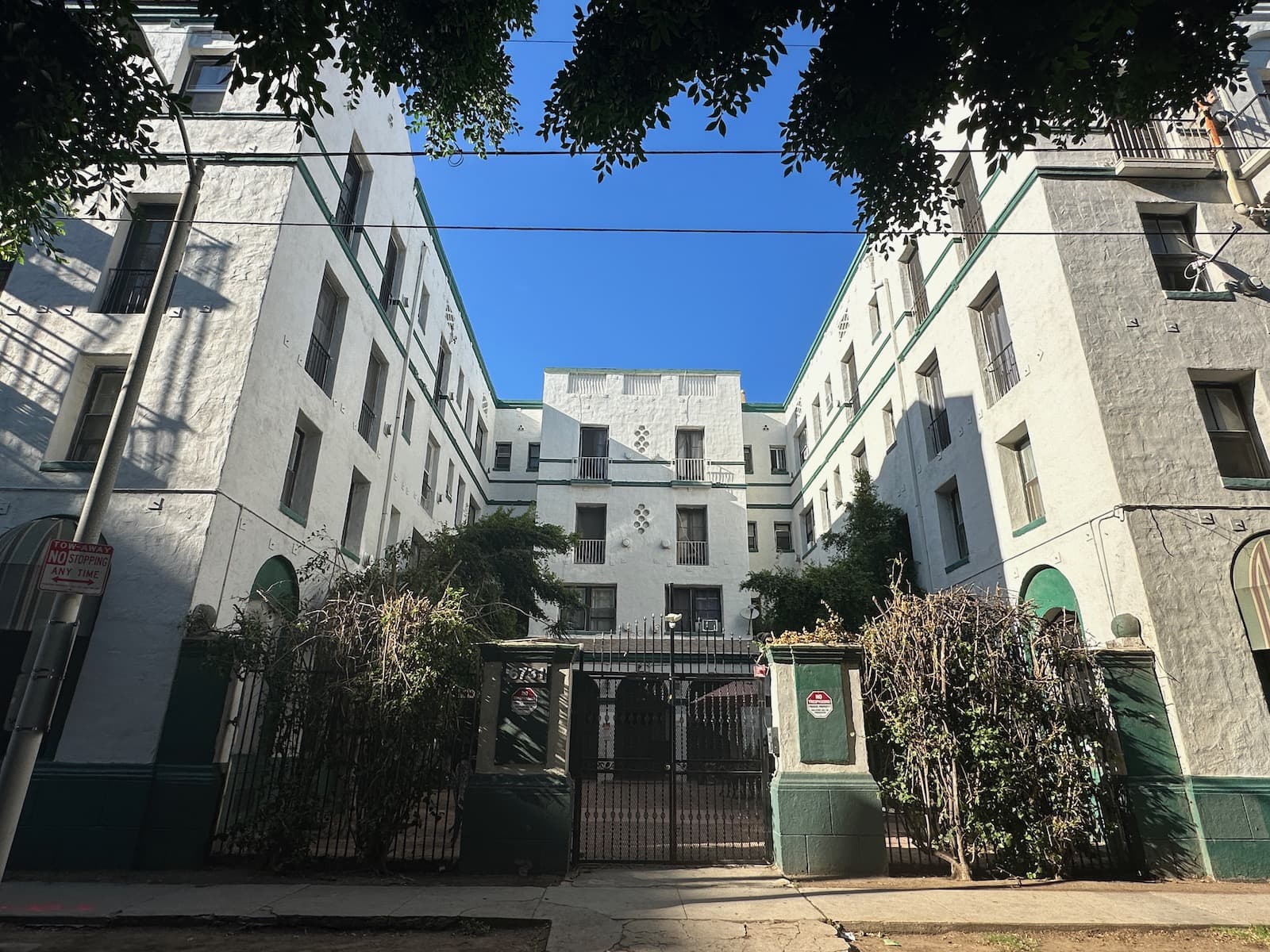
The Aloha Apartments were built in 1928 as a hybrid apartment building/hotel. There were a few starlets that lived here, but most of the Aloha’s tenants were middle-class professionals. It's a great example of how the housing market was changing to meet the needs of all the different kinds of people flowing into Hollywood during the 1920s and ‘30s.
For over a century, the Rose Bowl in Pasadena has played host to some of college football's most-watched games (plus: the world's biggest flea market!). And while it's earned its place in sports lore many times over, the Rose Bowl also has a fascinating, evolving history as a work of architecture.
Embodied in this opulent craftsman home are the history of the Victoria Park neighborhood, the legacy of the eminent architects Train & Williams, and the fascinating backgrounds of financier Nellie Shannon, her husband Michael (the first traffic cop in LA) and their son Michael Francis, who once served as Grand Exalted Ruler of the Elks.
The well-preserved Victorian house at 1360 Lida Street is one of the few 19th century remnants in Linda Vista, Pasadena's wealthiest neighborhood. It was built in 1888 at a critical juncture for the neighborhood, as it was transforming from sleepy rural farmland to an exclusive bedroom community of entrepreneurs and working professionals.
Malaga Cove Plaza was the first commercial center built in the first subdivision of Palos Verdes. Though its buildings span decades and architects, it all hangs together thanks to a uniform Mediterranean vibe.
Bowen Court (1911), designed by Arthur & Alfred Heineman, is the oldest bungalow court in Pasadena still standing in its original location. It's also the quintessence of the style: 23 craftsman cottages, each one with its distinctive quirks, all centered around a wide walkway with nary a car in site.